


Video advertising effectiveness now depends on whether an ad earns real attention, not just whether it is served, reported, or counted as viewed.
No marketer sets out to buy waste. No brand team signs off a media plan hoping its best creative will disappear into the scroll, the skip, the mute button, or the gap between an ad being delivered and a human actually paying attention.
Yet that is where a large share of video investment still goes.
This is the uncomfortable argument inside The Eye-Watering Cost of Dull Media: The Down Under Edition, which is a study led by Dr Karen Nelson-Field of Amplified, with contributions from Adam Morgan, Peter Field and Omnicom Media Australia. It puts a price on something the industry has long undercounted: advertising that is served, paid for, reported, and barely seen.
The research is built around Australian media conditions, but the problem is not limited to Australia. It appears wherever attention is traded down to impressions, and wherever creative is expected to work inside environments that give it too little time to register.
Video Advertising Effectiveness Needs More Than Delivery Receipts
The industry has become very good at proving that an ad was delivered. It is less good at proving that the ad was actually seen in a way that could change memory, choice, or behaviour.
Impressions, viewability and watch time still sit at the centre of too many media conversations. They validate delivery, but they do not confirm human attention. A video can be viewable while the viewer looks away. An impression can be counted while the brand is missed. A completed view can still carry very little active attention.
This is why the study uses Attention Volume as the key measure. Attention Volume asks how much attention an ad actually achieved against how much was possible if viewers had stayed engaged. It looks at how many people watched, how long they stayed, and how quickly attention decayed. In plain terms, it shows whether the audience was truly present for the ad, or whether the ad was simply present on a screen.
That distinction matters. Video advertising has more inventory than ever. More dashboards. More reported reach. But the scarce resource is still human time.
What the Dull Media Study Measured
The study looked at approximately 183,600 ad views across eight brands and six video formats. Around 3,600 of these were real human views measured across cinema, Facebook and YouTube using eye tracking and facial detection in natural environments. The remaining 180,000 were AI-modelled ad views (based on the response from the previous edition of the Dull Media Study), created to extend the analysis across Instagram, TikTok and BVOD TV.
The useful part is the comparison. The same brands appeared across every format, covering eight categories such as banking, telco etc. That means the study was not simply comparing one strong ad with one weak ad. It was looking at what happens when the same campaign assets are placed into very different attention conditions.
The study then connected three things: attention, media cost and brand outcome. It measured whether attention led to short-term brand choice, through Short-Term Advertising Strength (STA), and whether it helped build future memory through Mental Availability (MA).
In simple terms, it asked a question every marketer should care about: when the same ad runs across different video environments, which environment gives it the best chance to be seen, remembered and chosen? For a deeper look at the methodology, sample and full findings, access the complete study here: Amplified Study Reveals $198B Cost of Poor Media
Why Attention Changes Video Advertising Effectiveness
The study grouped video formats into three levels based on Attention Volume: Non-Dull, Moderately Dull and Very Dull.
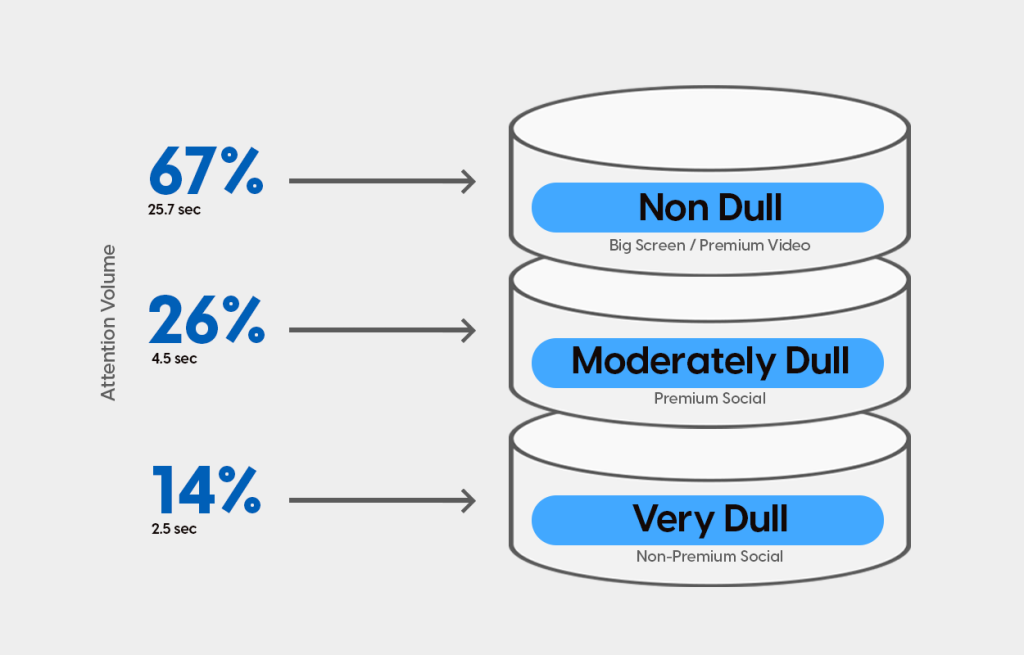
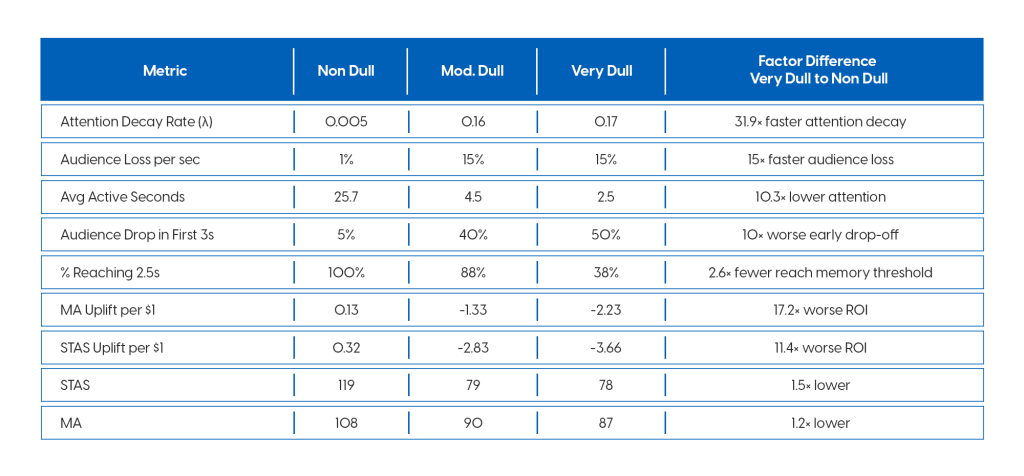
The gap between them is severe. Non-Dull formats delivered an average of 25.7 seconds of active viewing. Moderately Dull formats fell to 4.5 seconds. Very Dull formats delivered only 2.5 active seconds, with just 14% Attention Volume. In the study’s classification, Big Screen and Premium Video sat in the Non-Dull group, Premium Social sat in Moderately Dull, and Non-Premium Social sat in Very Dull.
The decay numbers sharpen the point. Very Dull formats recorded a 31.9x faster attention decay rate than Non-Dull formats, 15x faster audience loss per second, 10.3x lower average active attention, and 10x worse early drop-off in the first three seconds. Wastage rose from 33% in Non-Dull media to 86% in Very Dull media.
This is where the issue stops being a media efficiency debate and becomes a brand growth problem.
If people “leave” before the brand appears, memory does not form. If attention collapses before the message lands, the creative cannot do its job. If the audience is technically exposed but “not present” long enough to connect the story, the asset and the brand, the campaign may still look healthy in the report while failing in the mind.
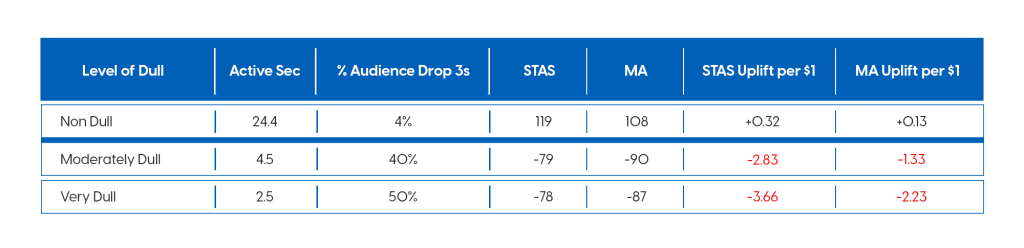
The study shows that weak attention can do more than reduce performance. It can reverse it. STAS uplift per dollar moved from +0.32 in Non-Dull media to -3.66 in Very Dull media. Mental Availability uplift per dollar moved from +0.13 to -2.23. That is the brutal part of the argument: in the wrong environment, a brand may be paying for exposure that helps a competitor more than itself.
Why challenger brands should worry most
Dull media hurts every brand, but it does not hurt every brand equally.
Established brands have memory structures already in place. Their logos, colours, assets and associations can sometimes survive brief exposure because buyers already know them. Challenger brands do not have that cushion. They need attention because their advertising has to build the memory bigger brands already own.
The study shows this penalty clearly. Challenger brands suffer a much steeper drop across STAS, MAs and ROI when media gets duller. The report also warns larger brands against efficiency blindness. Big brands may still see short-term performance because they are harvesting existing demand, but stronger attention environments could have delivered higher short-term uplift and stronger long-term memory.
How Brands Should Plan for Better Video Advertising Effectiveness
The answer is not simply more budget. It is sharper planning.
Brands need to replace proxy metrics with attention data. They need to audit media plans by the quality of human time, not only the quantity of reported impressions. They need to stop assuming strong creative can survive every environment. They need to reveal the brand early enough to be encoded, strengthen distinctive assets, and match their media mix to the realities of brand size.
For cinema, the relevance is clear without forcing the point. The study places Big Screen and Premium Video in the Non-Dull category, where attention lasts longer, decay is slower, and the brand has more time to be processed. That does not make cinema the answer to every brief. It does show why the big screen continues to hold a rare position in video planning: it gives advertising the one thing most platforms are struggling to protect, a real audience with enough time to register what is in front of them.
The industry has spent years optimising the cost of reaching people. The sharper question now is whether those people were truly reached at all.
Because the cost of dull media is not only wasted spend. It is the brand memory that never formed, the choice that never shifted, and the competitor that gained from attention your brand thought it had bought.
Related Articles:
The Science of Connection: Why Cinema Advertising Delivers Unmatched Brand Impact