

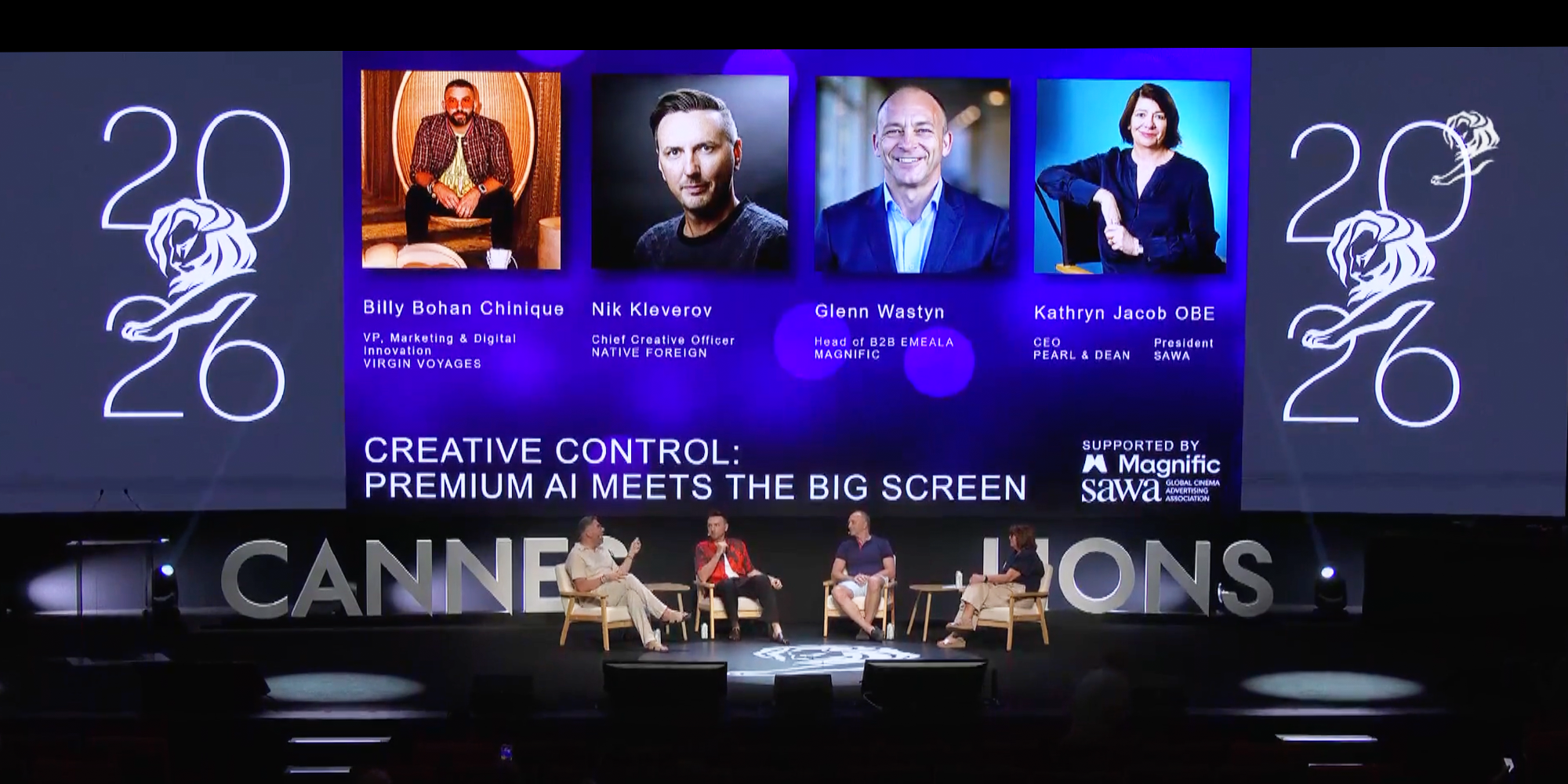
At Cannes Lions 2026, SAWA, the Global Cinema Advertising Association of which Motivate Val Morgan is a member, convened a session on the question the advertising industry keeps circling: as AI spreads through every part of the creative process, what does it take to produce work the big screen will actually accept? The panel brought together cinema, creative technology, filmmaking and brand marketing, and across the hour the answer held steady. Cinema is the benchmark, and AI has to rise to meet it.
The session was set up by SAWA President Kathryn Jacob OBE, CEO of Pearl & Dean, who framed the big screen as a medium that demands attention, demands craft, and demands respect for an audience that has given over its time. She joined Joaquin Cuenca, Founder and CEO of Magnific; Billy Bohan Chinique, VP of Marketing and Digital at Virgin Voyages; and Nik Kleverov, Chief Creative Officer at Native Foreign.
Premium AI Is About Control, Not Volume
Cuenca made the central case that premium AI is defined by intent rather than how much content it can produce. He traced his platform’s evolution toward greater control at every stage, from a single prompt through to brand-trained agents that hold to a company’s guidelines and tone. His illustration was one media planners will recognise: Audi, BMW and Mercedes build comparable products with shared engineering roots, yet each brand feels entirely its own. That distinctiveness is controlled, and good AI has to protect it. The mistake, in his view, is treating the technology as a button to push for more output. The discipline is to use control and create.
Brands Need Guardrails Before They Need AI
For Bohan Chinique, the value was in telling stories that Virgin Voyages (a premium, adults-only cruise line founded by Richard Branson’s Virgin Group) could not previously afford to produce. Each Virgin ship carries an illustrated mermaid on its hull, drawn by women artists, and the origin stories behind them had never been commercially viable at a cinematic standard. What stood out was the discipline around where the brand would and would not use AI. Virgin pledged not to sell synthetic vacations, refusing to place a ship anywhere it has not sailed, and committing to send a human to capture the real thing wherever possible. The result was a series of mermaid films built for cinema, with the latest installments receiving their live world premiere in the SAWA seminar room. The lesson for marketers is that the brands getting this right defined their limits first.
The Human Creative Matters More, Not Less
Kleverov, who has directed multiple title sequences including the one for Narcos, offered the filmmaker’s read, and his theme was that the fundamentals have not changed. A great story and great creatives have to remain at the heart of every piece. He was direct about the technology’s limits, noting that AI outputs are still imperfect and that a trained creative eye is what separates usable work from the rest. He pushed back firmly on the headline-chasing claim that a finished film can be made in a couple of hours for a couple of dollars, arguing that this misrepresents how creative actually happens. The efficiencies are real, but the creative thinking still has to come first.
More, Not Just Cheaper
A point worth carrying back to client conversations was the panel’s reframing of what AI is for. The lazy assumption is faster and cheaper. The speakers argued the opposite. The strongest brands use the technology to do more, not less. A single global campaign can become twenty, localised across cities, languages and characters, making audience outreach genuinely more personal rather than simply more economical. That demonstrates the shift from efficiency to effectiveness, and it is where the real value sits.
Why Cinema Stays the Standard
For a cinema advertising business, the reason the big screen kept resurfacing as the benchmark is straightforward. It remains the most effective environment in which to tell a story. Audiences arrive with their attention already given to the cinema screen for viewing content they have chosen and travelled to see. AI can help more brands reach that standard, but cinema is what sets it. As Jacob put it in closing, the best storytelling is always on the big screen.
Kleverov summed up the signal beneath the noise in three points. There is no magic button, creatives are needed more than ever, and great storytelling will ultimately prevail. For an industry still working out how to use these tools with craft, cinema offers both the test and the destination.
Reporting: Motivate Val Morgan, from the SAWA session at Cannes Lions 2026
Related Articles:
Why Being Seen Has Become Video Advertising’s Biggest Problem